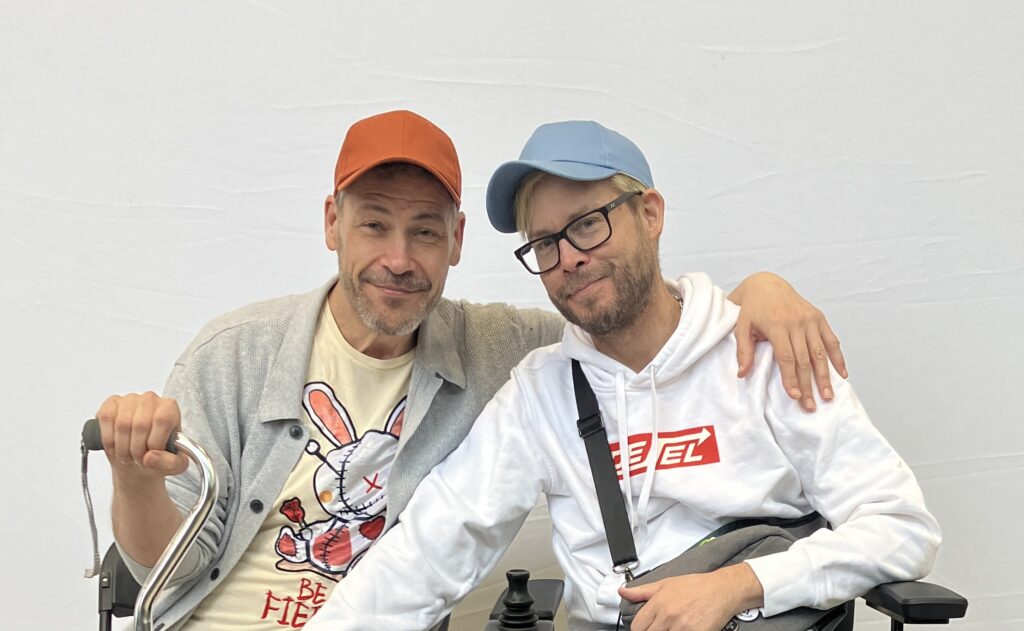

Pride is often associated with celebration, visibility, and progress. But for Jeff and Troy, Pride is also about advocacy, accessibility, and ensuring that no one is left behind.
As members of both the 2SLGBTQIA+ and disability communities, their experiences reveal the unique challenges that can arise at the intersection of multiple identities. Their stories highlight the importance of creating spaces where people can bring their whole selves—not just one part of who they are.
What Pride Means Today
Like many people, Troy’s relationship with Pride has evolved over time.
“Pride for me used to be more about being in-your-face and refusing to let people tell me what to do,” he says. “Now it’s about being part of a community, caring for each other, and treating people with respect.”
For Jeff, Pride has always been rooted in activism.
“I’ve always seen Pride as a protest,” he explains. “While we’ve made progress, there are still barriers and issues that need to be addressed. Sometimes people want Pride to be only a celebration, but I think it’s important that we continue talking about inclusion and equity.”
That perspective became even more significant after Jeff acquired a spinal cord injury in 2022.
Navigating Pride as a Disabled, Queer Couple
Both Jeff and Troy live with forms of ataxia, a neurological condition that affects movement and coordination. Their experiences have given them a unique perspective on accessibility within the queer community.
Jeff points out that many LGBTQ+ spaces remain difficult or impossible to access for people with disabilities.
“Whether it’s a gay bar in a basement or a community organization operating out of a heritage building, accessibility is often overlooked,” he says. “It highlights how much work we still have to do.”
Troy has experienced similar challenges firsthand.
“We’ve been to events that are technically wheelchair accessible,” he says. “But if I have to ask every person to move so I can get through, that’s exhausting. Accessibility isn’t just having a ramp—it’s creating an environment where people can fully participate.”
Their experiences serve as a reminder that inclusion requires more than meeting minimum accessibility standards. It means designing events and communities with diverse needs in mind from the beginning.
Being Seen in All Parts of Your Identity
For Jeff, representation can be complicated.
As someone who is bisexual, disabled, and older, he often feels that only portions of his identity are recognized at a time.
“There is still a lot of bi erasure,” he says. “If you’re in a relationship that appears heterosexual, people assume you’re straight. If you’re in a same-sex relationship, people assume you’re gay. Either way, part of your identity gets erased.”
He also notes that many queer spaces place a strong emphasis on youth and physical appearance.
“When you’re older or disabled, there can be dismissive attitudes. It can be difficult to feel fully represented.”
While support exists, Jeff says it is often separated into silos. Disability communities may understand one aspect of his experience, while LGBTQ+ communities understand another.
Finding spaces that recognize both identities simultaneously has been much harder.
Finding Community at the Intersection
One place where both Jeff and Troy have found that connection is SCIO’s 2SLGBTQIA+ Virtual Support Group.
“It’s the closest thing we have to a space where our intersecting identities are acknowledged and discussed,” Jeff says.
Everyone in the group has a spinal cord injury or similar disability and identifies within the rainbow community. While their experiences differ, participants share common ground through both disability and queer identity.
“At our core, we are disabled and queer,” Jeff says. “Our stories resonate with one another.”
For Troy and Jeff, community also starts at home.
The couple share many similarities, including living with acquired forms of ataxia, Dutch heritage, and religious upbringings. Their connection is rooted in mutual understanding, resilience, and advocacy.
“Our primary connection is to each other,” Jeff says. “We’re both fierce, proud, and stubborn—which is why we’re good self-advocates.”
Advocacy as a Lifelong Skill
Advocacy is a recurring theme throughout both of their lives.
As a queer youth in the 1980s, Jeff participated in protests and supported transgender friends who faced harassment and discrimination.
“Those experiences taught me how to advocate,” he says. “Now, when I’m navigating the healthcare system or facing barriers related to disability, I know how to speak up for myself.”
Troy shares that same determination.
“I’m proud that we’ve persevered through our disabilities while navigating being gay at the same time,” he says. “I’m not going to stand down just because I’m in a wheelchair.”
He is also proud to be openly gay while teaching online cooking classes for people with disabilities.
“Representation matters,” he says. “It’s okay to be yourself. It’s okay to be out and proud. Be who you are and live the life you’re meant to live.”
Looking Forward
When asked whether they feel seen and celebrated, both men acknowledge that there is still work to be done.
Troy believes disability rights deserve greater visibility within Pride celebrations and LGBTQ+ communities more broadly.
Jeff agrees, noting that true inclusion requires recognizing people in all their complexity—not just one aspect of their identity.
Their message to others navigating similar experiences is simple but powerful: trust yourself, advocate for your needs, and don’t let others define what is possible.
“Challenge assumptions,” Troy says. “You know yourself best. Let your own compass guide you on what you need in terms of support, inclusion, and engagement.”
As Pride continues to evolve, stories like Jeff and Troy’s remind us that meaningful inclusion requires more than visibility. It requires listening, accessibility, and a commitment to ensuring everyone has a place in the community.
Because Pride is strongest when everyone belongs.