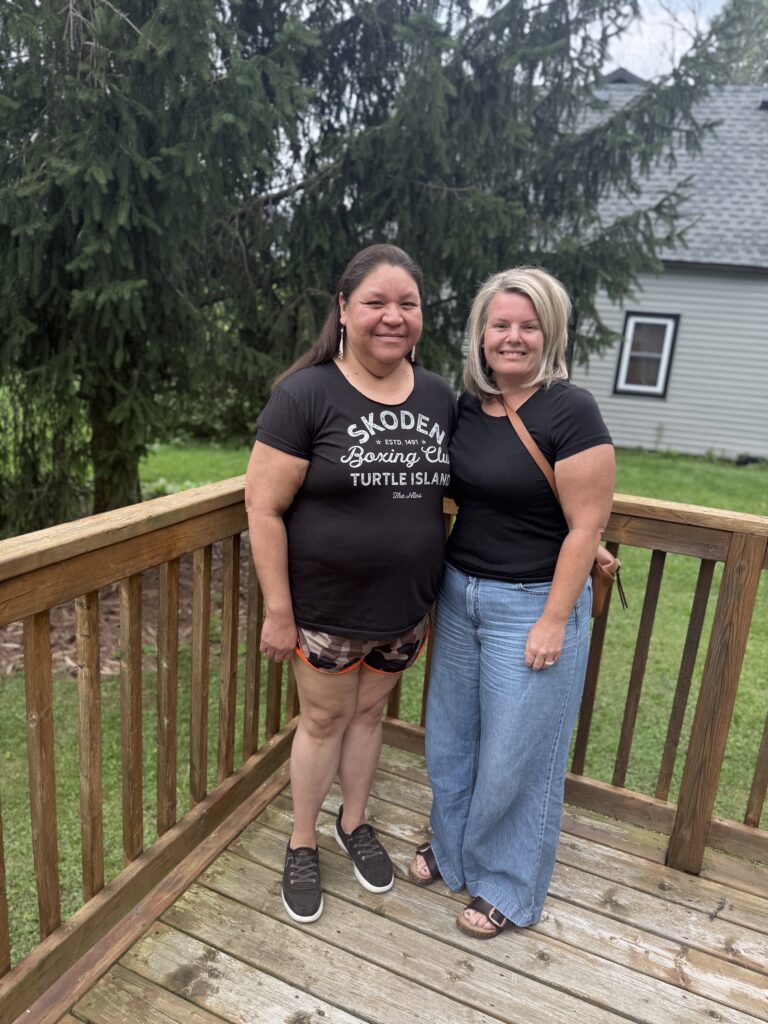
In recognition of the National Day for Truth and Reconciliation, Spinal Cord Injury Ontario (SCIO) is honoured to share Sonya’s story, with her permission. From Six Nations of the Grand River Territory, Sonya reflects on her spinal cord injury journey, navigating health care and rehabilitation, the importance of family, culture and community, and what health-care providers can learn from her lived experience.
Sitting in her home on Six Nations of the Grand River Territory, Sonya welcomed us in and began sharing a story that, at times, was difficult to tell.
Several times during our conversation, she paused as tears came to her eyes. Looking back meant revisiting a period filled with uncertainty, complicated medical care, separation from family and a sudden loss of independence.
But around us were also signs of how far she has come.
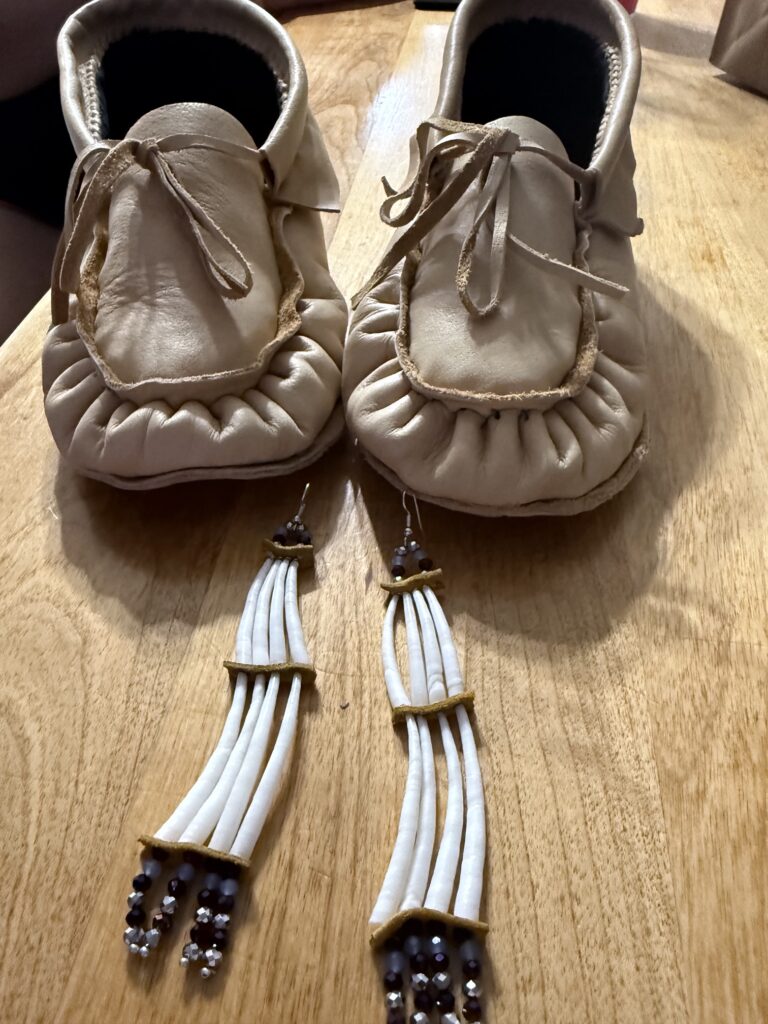
Sonya proudly showed us a new project she has been working on: handmade jewellery and hand-stitched moccasins. She welcomed us to take a photo and talked about the things she is able to do today.
Those moments offered a striking contrast to where her story began.
When something didn’t feel right
Around 2019, Sonya began experiencing tingling in her feet.
“Then it slowly started going up my legs,” she recalls.
As the symptoms progressed, she became increasingly unstable. She contacted her doctor and underwent testing, but there was no immediate explanation. While waiting for further nerve and muscle testing, Sonya fell down 14 stairs at her apartment.
Eventually, during a medical appointment, a member of her care team noticed how much difficulty Sonya had sitting up from the examination table. An MRI was arranged soon afterward.
Finally, there was an answer: bone spurs were putting pressure on her spinal cord.
Sonya underwent spinal surgery, followed by complications, additional procedures and eventually a second surgery. Her independence changed dramatically, and she required significant assistance with everyday activities and transfers.
She remembers not fully understanding what life might look like following surgery.
“I thought I was just going to have surgery and be, like, done,” she says. “I thought I’d be able to walk and everything.”
That experience has stayed with Sonya and shaped something she wants health-care professionals to understand: communication matters.
“Some nurses or people are just there and don’t really explain things, or what’s going to happen and what to expect,” she says.
Navigating an unfamiliar system
During her rehabilitation, Sonya connected with Kristy Hamilton, a Service Navigator SCIO, through the rehabilitation team at Hamilton Health Sciences.
As Sonya moved through different stages of care, Kristy remained connected with her. That continuity became particularly meaningful when COVID-19 added another layer of isolation and uncertainty.
“The hardest thing was because it was COVID still and we couldn’t have family in,” Sonya says. “That was the worst part of everything.”
Sonya was eventually repatriated to her community hospital, where she would spend approximately a year.
As an Indigenous woman from Six Nations of the Grand River Territory, she says previous health-care experiences involving herself and members of her family left her concerned about racial bias and how she might be treated.
“I was always worried about going there because of the racial stuff there, and we always get treated differently there,” she says of her concerns at the time.
But Sonya was also prepared to advocate for herself.
“I was at a point where I could advocate for myself,” she says.
Her experience also highlighted the importance of consistent, culturally relevant navigation and support.
Sonya recalls having access to an Indigenous patient navigator at one point during her care, but says the connection wasn’t sustained. For someone receiving treatment away from their home community, she says navigating an unfamiliar health-care system can be particularly difficult.
“A lot of us go there not really being in the city,” she says. “They don’t know what they’re allowed to do at the hospitals and what they have access to, or any kind of supports.”
Sonya is careful to speak from her own lived experience rather than for all Indigenous people. But there are lessons she hopes health-care professionals will hear: explain what is happening, listen, ask questions and don’t make assumptions.
Finding creative ways forward
Although her community hospital didn’t have all of the specialized neurological rehabilitation resources Sonya had previously accessed, her physiotherapy team found creative ways to work toward her goals.
“They had a lot of time for me,” she says. “If it wasn’t for them, I don’t know.”
Sometimes rehabilitation looked surprisingly familiar. At one point, kneading dough became part of Sonya’s hand therapy—an everyday activity used to help her work on movement and function.
She had arrived requiring significant assistance. Slowly, things began to change.
One of those changes was captured on video.
A moment neither of them has forgotten
During our recent visit, Kristy and Sonya looked back at a video from those days in the community hospital.
Years earlier, a member of Sonya’s rehabilitation team had called Kristy with exciting news:
“How quickly can you get here?”
Kristy made the trip.
What she arrived to see was a milestone neither of them would forget: Sonya was walking with support.
Now, years later, they sat together in Sonya’s home watching that moment again.
Behind those few moments of video were surgeries, setbacks, isolation, uncertainty and countless hours of work.
Revisiting those memories brought tears. Sonya stopped several times while sharing her story, giving herself time before continuing.
Sharing a spinal cord injury story can mean returning to some of the most difficult moments in a person’s life. Sonya generously allowed us into those memories—and into the moments of progress that followed.
An accessible apartment, but not home
Leaving hospital was another milestone, but it didn’t mean Sonya could return home to Six Nations.
A shortage of accessible housing in her home community meant she spent approximately a year living in March of Dimes supportive housing off the reserve. The apartment provided accessibility and personal support worker care, but something essential was missing.
It wasn’t home.
Living in the city meant navigating an environment and cultural norms that felt very different from those of her home community. While the apartment met important accessibility and support needs, Sonya’s goal remained the same: to return to Six Nations, to her community and her family.
Perhaps nothing captures that feeling more clearly than what Sonya did with her belongings.
She never fully unpacked.
She knew the apartment was temporary. Accessible or not, it wasn’t where she wanted to build her life.
Her experience highlights an important dimension of accessibility that can sometimes be overlooked. A person’s needs aren’t defined solely by whether a doorway is wide enough or personal care is available. Belonging, culture, family and connection to community matter too.
For Sonya, accessible housing needed to mean more than an accessible apartment. It needed to allow her to be home.
Family, community and independence
Throughout the journey, Sonya’s family remained an important source of support. Her son, Kiefer, travelled back and forth to Hamilton, while her husband, Curtis, supported her through hospital stays, rehabilitation and the transition back into the community.
“It was rough,” Sonya says. “But we managed.”
Eventually, Sonya made it back to Six Nations.
Other milestones followed.
A trip to Oklahoma helped her realize that travel and greater independence could still be part of her life.
“I found that I was able to travel again and eventually do stuff on my own and start getting more independent,” she says.
Then came another significant milestone: driving.
Not long after returning home to Six Nations, Sonya began driving again, including taking her mother out.
For Sonya, getting behind the wheel represented much more than transportation.
“My independence instead of dependence,” she says.
Today, driving is one of her favourite things to do.
“The same old me”
Back in Sonya’s home, there are signs everywhere of the life she continues to build: the handmade jewellery, the moccasins she carefully stitches, the projects she is excited to share and the freedom to get in her vehicle and go for a drive.
When asked whether her spinal cord injury changed who she is, Sonya doesn’t offer a dramatic answer.
“I guess I’m still the same old me,” she says.
Perhaps that says more than anything else could.
Sonya’s journey has included uncertainty, setbacks and difficult experiences, but also family, community, self-advocacy, creative rehabilitation and people who remained connected along the way.
Her story also offers an important reminder about what meaningful support can look like. Accessibility matters, but so do culture, belonging and the ability to remain connected to home and community. Sonya’s experience also points to the importance of listening to Indigenous patients, recognizing assumptions and bias, communicating openly, and ensuring culturally relevant supports are accessible and consistent.
As our visit came to an end, Sonya’s story wasn’t defined only by the difficult memories she had generously shared.
It was also right there in front of us—in the home on Six Nations she had worked so hard to return to, in the jewellery and moccasins she was creating, in the video she and Kristy could now watch together, and in the independence she had reclaimed.
After everything, she is still, in her own words, “the same old me.”
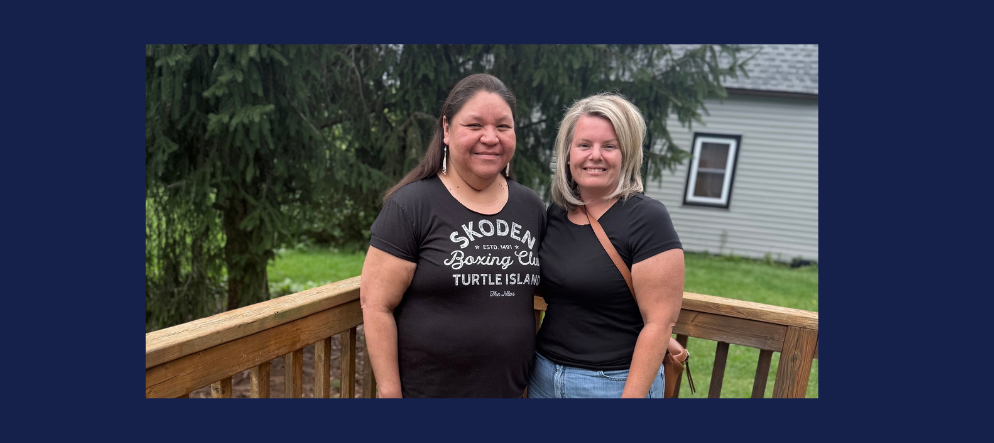
Photo Left: Sonya with Kristy Hamilton, SCIO Service Navigator. Photo: Moccasins and jewellery handmade by Sonya