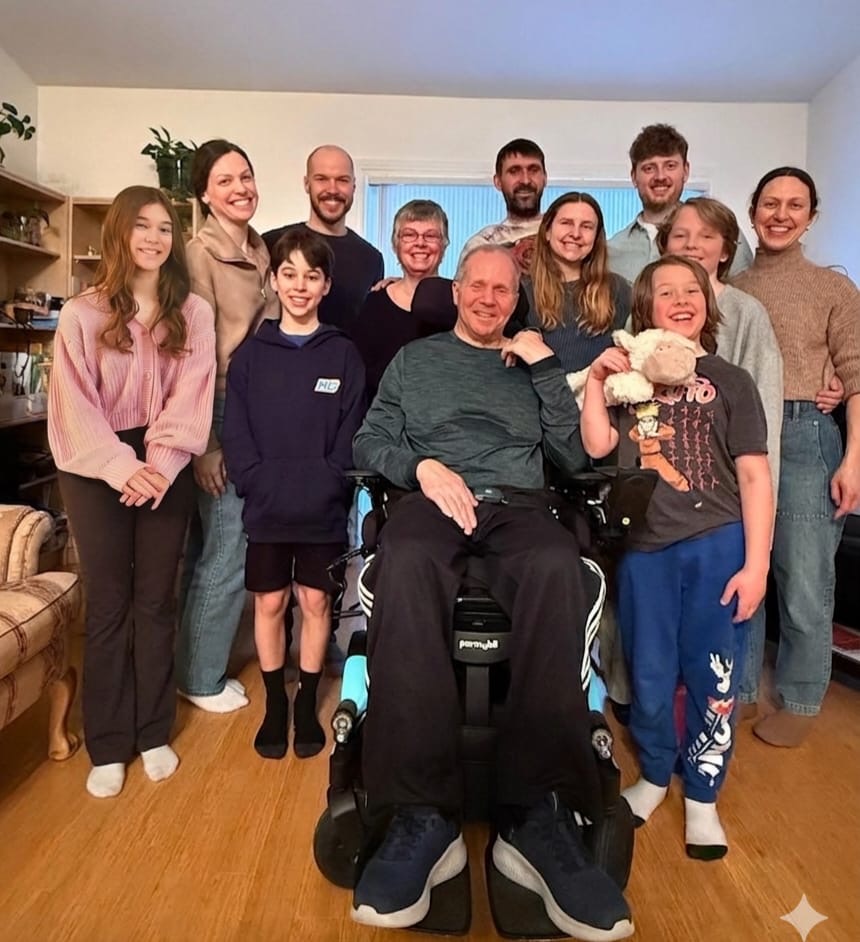

When Jeff Arbus left rehabilitation after his spinal cord injury, finding a home became one of the biggest obstacles to rebuilding his life.
At 73, the retired college teacher suddenly found himself navigating a world that wasn’t designed for people using wheelchairs. What followed was an exhausting search for accessible housing that revealed just how far accessibility still has to go.
Initially paralyzed from the collarbone down and dependent on a ventilator, Jeff has since regained some function. But recovery has involved far more than physical rehabilitation.
“When it comes to SCI, my entire family has had to cope with all of it too,” he says. “The trauma goes well beyond me.”
A Search for an Accessible Home
For Jeff and his family, one of the first realities they faced was housing.
Their multi-level home in Sault Ste. Marie simply couldn’t be made accessible. Narrow doorways, multiple levels and structural barriers meant they had no choice but to look elsewhere, beginning a search that stretched from Sault Ste. Marie to Toronto.
“We were really thinking that relocating would be best,” Jeff says. “We focused our attention on Toronto and had some help from Lyndhurst and SCIO Service Navigation Coordinators. This was brand new to us. We knew nothing about extra-wide doorways and ramp angles.”
Throughout the process, Jeff and his family received support from SCIO’s Service Navigation team, helping them better understand accessibility requirements and navigate unfamiliar systems during an incredibly stressful time.
At the same time, Jeff was adjusting to life in a power wheelchair while his daughters searched tirelessly for housing. Together, they explored roughly 50 properties online and in person.
What they found was discouraging.
“It was a shock to our system because landlords let it be known that accessible units were not available because they’d been rented out to people who didn’t need them.”
Even buildings advertised as accessible often fell short in practice.
Some condo ramps were too steep to use safely with a power wheelchair. Elevators were too small for Jeff to turn around. In other apartments, he could enter the building but couldn’t navigate the hallways, access the bathroom or transfer safely using a Hoyer lift.
“At the time, I was still a quadriplegic, so the bathroom faucets were a major barrier too, with limited hand movement.”
After an exhaustive search, the family finally found a home in a new subdivision in Sault Ste. Marie. Even then, significant renovations were needed, including widening doorways and completely rebuilding the bathroom.
“Thankfully, we didn’t need permits from the city. We faced major disappointments in Toronto and decided to stay in Sault Ste. Marie, where we’ve lived for 49 years.”
More Than Finding a Home
Finding an accessible home was only one part of an overwhelming transition.
Alongside the housing search, Jeff and his family were navigating insurance claims, securing medical equipment, arranging personal support workers before discharge and ensuring he had the equipment needed to live safely at home.
“It’s completely emotionally overwhelming.”
Jeff says one of the most difficult parts of the experience was seeing the impact his injury had on those closest to him.
“At the start, I blamed myself a lot for all of the trauma that the whole family had to deal with because of the injury.”
His experience highlights a reality that many families face after a spinal cord injury: recovery extends far beyond the individual and often requires loved ones to navigate complex systems, make major life changes and provide ongoing support.
Accessibility in Theory vs. Reality
Looking back, Jeff believes one of the biggest challenges is the gap between accessibility standards on paper and accessibility in real life.
“They skirt around the letter of the law but don’t really have an understanding of what accessibility is. I really shudder to think about some of the people at Lyndhurst who have yet to be discharged from rehab. I have a supportive family and was one of the luckier ones. Not everyone does, and that must be very difficult.”
Jeff hopes governments, builders and decision-makers will include people with lived experience when shaping accessibility policies and move beyond simply meeting minimum standards.
“Accessibility needs to be seen as part of the structure from the beginning rather than an afterthought,” he says. “As a newcomer to this space, accessibility immediately creates an image of walkers or wheelchairs. But with an aging population, accessibility is much more universal. It influences construction, bylaws and the resources available to the people responsible for enforcing them. Organizations like SCIO need to be part of those discussions and partners in development. Without that, accessibility becomes an afterthought.”
Jeff’s story is a reminder that accessibility isn’t just about getting through the front door. It’s about creating communities, homes and systems that allow people to live safely, independently and with dignity from the very beginning.
Accessible communities don’t just benefit people living with spinal cord injuries—they create spaces where everyone can thrive, today and into the future.